Employees can send an unpaid wages demand letter to an employer who has failed to pay them the wages they’re owed. Sending a well-drafted demand letter to your employer is an effective and straightforward way to demand your wages.
Table of Contents
What Is an Unpaid Wages Demand Letter?
An unpaid wages demand letter is a formal written request for missing compensation. It is usually sent by an employee or former employee to an employer, payroll department, manager, or business owner.
The letter identifies the unpaid amount and explains how it was calculated. It also gives the employer a reasonable deadline to correct the issue.
You may use a demand letter to request:
- Regular hourly wages
- Unpaid salary
- Overtime pay
- A missing final paycheck
- Unpaid commissions
- Earned bonuses
- Tips collected but not distributed
- Reimbursement required under applicable law
- Payment for off-the-clock work
- Illegal payroll deductions
- Accrued vacation pay when state law or company policy requires payment
A demand letter is not the same as filing a lawsuit. It is an attempt to resolve the dispute directly before using a government complaint process or court action.
In many cases, the employer may correct the payment after receiving clear documentation. Payroll errors, missing timesheets, incorrect employee records, and approval problems can sometimes be resolved without a formal legal claim.
However, the letter also creates a written record. That record may become useful if you later contact a labor agency or attorney.
Why should you send a demand letter for unpaid wages to your employer?
Here are the reasons for sending a demand letter to your employer before taking legal action;
- Before filing a lawsuit in most states, you may have to demand payment from the employer.
- You can better organize your letter with the help of a demand letter. The letter helps you think through every aspect of your case if you end up filing a lawsuit. Before you file a lawsuit, the demand letter helps you to prepare for litigation.
- Furthermore, your demand letter can be used as proof in court. When you present the letter in court, it will show the judge that you have tried to resolve the dispute outside of court.
- By sending a demand letter, you can receive your wages without legal action.
What Counts as Unpaid Wages?
Unpaid wages include more than a completely missing paycheck. The term can cover many forms of compensation earned through employment.
Regular wages
Regular wages are the hourly or salary payments you were promised for completing your work. A claim may arise when an employer fails to pay an entire pay period or leaves certain hours off your check.
Unpaid overtime
Under the federal Fair Labor Standards Act, covered nonexempt employees generally must receive overtime pay after working more than 40 hours in a workweek. The federal overtime rate is normally at least one and one-half times the employee’s regular pay rate.
Some states provide broader overtime rights. For example, state law may require overtime after a certain number of hours in one day.
Off-the-clock work
Time spent performing required job duties may count as compensable work. This can include opening a workplace, closing a register, attending required meetings, completing paperwork, or responding to work requests after clocking out.
The U.S. Department of Labor explains that covered employees must receive at least minimum wage for compensable hours. Covered nonexempt workers must also receive applicable overtime pay.
Missing final paycheck
A final paycheck may include regular wages through the employee’s last day. Depending on state law and company policy, it may also include commissions, bonuses, or unused paid leave.
Final paycheck deadlines are mainly controlled by state law. Your demand letter should identify your last day, the covered pay period, and the regular payday.
Unpaid commissions and bonuses
Federal minimum-wage law does not provide a general collection process for every promised commission or wage above the federal minimum. Claims involving promised wages, commissions, bonuses, or fringe benefits often depend on state law and the employment agreement.
Save your commission plan, sales reports, offer letter, bonus policy, and customer payment records. These documents may show when the commission became earned.
Unlawful deductions
An employer may sometimes make lawful deductions for taxes, benefits, or authorized items. However, other deductions may violate federal or state law.
Record the gross pay, each deduction, and the amount you received. Request a written explanation for any deduction you do not understand.
Information to include in your demand letter:
Your demand letter for unpaid wages must include the following information;
- The most important part of the letter is the background facts that explain the wages that are owed. In the letter, include all the facts and details about the wages you are owed.
- When you are discussing facts or making your demand, try to use concise and polite language. Keep in mind that you have to resolve the matter without expanding it further. You should stick to the facts throughout the letter.
- Specify the method that your employer can use to pay the wages.
- The letter must include a deadline. It would be recommended to give at least 14 days to your employer to respond to you. Additionally, state in the letter that you intend to sue them if they do not respond within that time.
- At the end of the letter, affix your signature.
- Attach any important documents or proof with your letter.
Keep the letter in your record after sending it. Doing so helps you to bring it to the hearing and show it to the judge in case you do end up filing a small claims lawsuit.
What to Do Before Writing Your Demand Letter
A strong demand letter is based on dates, records, and calculations. Avoid sending an angry message before reviewing your evidence.
Confirm who legally employed you
Use the employer’s complete legal name in the letter. The name on the storefront may differ from the company shown on your pay stub or tax forms.
Look at:
- Your offer letter
- Pay stubs
- W-2 form
- Employee handbook
- Direct deposit records
- Business emails
- Employment agreement
- Company registration information
Address the letter to a person who can act on it. That may be the owner, human resources manager, payroll director, or company attorney.
Gather your employment records
Collect every document that supports your claim. Useful records include:
- Pay stubs
- Timecards
- Work schedules
- Clock-in records
- Employment contracts
- Offer letters
- Commission agreements
- Text messages
- Emails
- Bank statements
- Sales records
- Screenshots from scheduling apps
- Employee handbook sections
- Notes about earlier conversations
- Copies of previous payment requests
Employers covered by the FLSA must maintain certain records for nonexempt workers. These generally include hours worked, pay rates, overtime earnings, deductions, total wages, pay dates, and covered pay periods.
You should still keep your own records. The Department of Labor recommends writing down start times, finishing times, meal breaks, payment dates, and amounts when formal records are unavailable.
Calculate the amount owed
Your letter should state a specific amount whenever possible. Do not simply write, “You owe me money.”
Create a simple wage calculation table:
| Pay Period | Hours Worked | Pay Rate | Amount Due | Amount Paid | Balance |
|---|---|---|---|---|---|
| May 1 – May 7 | 40 | $20 | $800 | $600 | $200 |
| May 8 – May 14 | 45 | $20 | $950 | $800 | $150 |
| Total | 85 | — | $1,750 | $1,400 | $350 |
This is only an example. Overtime calculations may require the employee’s regular rate rather than the basic hourly rate alone.
Include separate lines for:
- Regular wages
- Overtime
- Commissions
- Bonuses
- Tips
- Reimbursements
- Deductions
- Payments already received
Do not add penalties, interest, or damages unless you understand the applicable law. You can reserve your right to seek any remedies available without naming an unsupported amount.
Review earlier communications
List the dates when you contacted payroll, management, or human resources. Save their responses.
This timeline helps show that you tried to solve the issue informally. It also prevents the employer from claiming that nobody reported the problem.
Check your deadline
Do not let repeated promises delay your claim indefinitely. Legal filing deadlines continue running while you wait.
Federal FLSA claims generally have a two-year limitation period. A three-year period may apply to willful violations. State wage-claim deadlines can differ, so prompt action is important.
How to demand unpaid wages?
Before taking legal action, a demand letter for unpaid wages provides you the chance to resolve the matter peacefully. Consider the following steps to demand unpaid wages;
Contact your state labor office
If your employers refuse payment, you should get in touch with your state labor office. They can advise you about your rights and assist you in resolving your unpaid wages case. Take the matter to the labor office regardless of the excuse your employer gives for failing to pay your wages.
Under the Fair Labor Standards Act, you are still owed those wages. Your state labor office can guide you on what to include in your demand letter.
Create an unpaid wages demand letter
Draft a formal demand letter after discussing the matter with your state labor office. Write the letter by using an appropriate tone and keep it to the point. In the letter, describe the wages you are owed, the actions you will take if they don’t pay by the deadline, and how they pay your wages.
Furthermore, provide your contact information and your complete address in the letter including street address, city, state, and zip code. Use certified mail to send your demand letter and keep the receipt of certified mail for the records.
Go to the local US Department of Labor office and ask them to contact your employer
Ask the U.S. Department of Labor office to contact your employer and demand them to pay your owed wages. Contact a government agency if your employer doesn’t take your demand letter seriously. On the other hand, if they agree to pay you and you receive your unpaid wages then move on with your next job.
To start your case, file a complaint and summons
Filing a complaint is the next step if your demand letter goes unanswered. You will state the following in your complaint;
- When the job ended
- When the wages went unpaid
- The amount you are owed
- The steps you took to collect payment
To prove that the letter was sent, attach a copy of your unpaid wages demand letter and the receipt of the certified mail. Along with your complaint, file a summons. This summons informs the employers that the case is being brought against them and they have to appear in court.
Get prepared to attend a court hearing
You have to prepare to attend a court hearing after filing a complaint. Thus, you need to pay a lawyer’s fee for representation. Also, to show your case to the judge, you have to gather all the documentation and evidence. However, a court hearing can give you confidence that your employer will not be able to get out of paying you if you understand your rights to your unpaid wages.
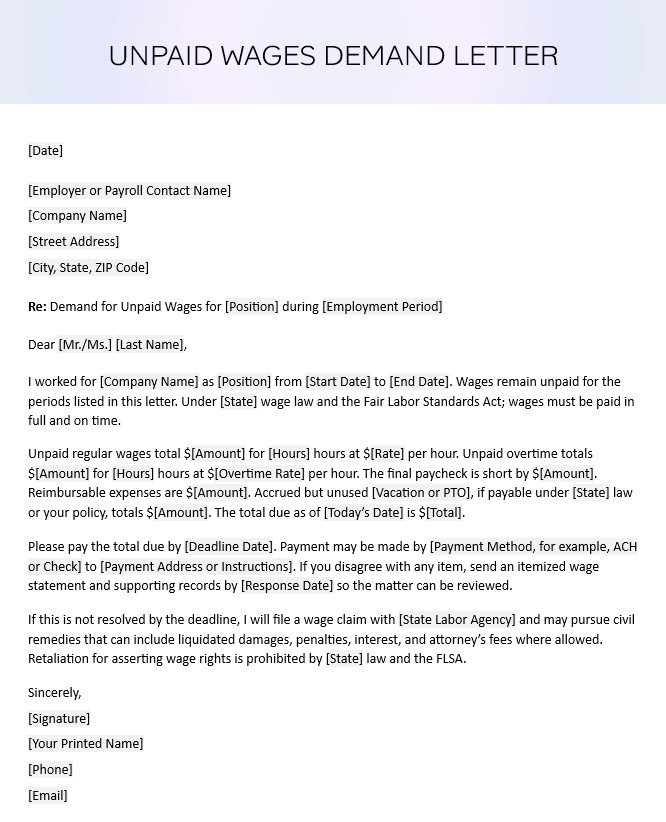
Unpaid Wages Demand Letter Template:
- Pay period or work dates: [Dates]
- Regular hours worked: [Number]
- Overtime hours worked: [Number]
- Agreed pay rate: [Rate]
- Regular wages due: [$ Amount]
- Overtime wages due: [$ Amount]
- Commission, bonus, or other compensation due: [$ Amount]
- Less any payment already received: [$ Amount]
- Total unpaid balance: [$ Total Amount]
Example of a Completed Unpaid Salary Demand Letter:
- 40 regular hours at $21 per hour: $840
- 8 overtime hours at $31.50 per hour: $252
- Unpaid performance bonus: $168
- Total amount due: $1,260
How to Send the Demand Letter
Send the letter through a method that creates proof.
A practical approach is to send it by:
- Certified or tracked mail
- Email with attachments
- Hand delivery with a signed receipt
- The company’s official payroll system
- More than one method at the same time
Keep a copy of the final signed letter. Also save delivery confirmations, email timestamps, and any responses.
Do not send your only copy of important records. Use copies and keep the originals in a secure place.
Your email subject line can read:
Formal Demand for Payment of Unpaid Wages
Avoid discussing the dispute through disappearing messages. Written communication with a reliable timestamp is easier to preserve.
Do you need to hire an attorney to write a demand letter?
It’s up to you whether or not you need an attorney to write a demand letter for unpaid wages. You can write it on your own as there is no specific requirement to hire a lawyer to write your demand letter. However, you can find many attorneys that specialize in claims relevant to unpaid wages. They are known as employment law attorneys or wage-and-hour attorneys.
Final Thoughts
An unpaid paycheck is not a minor inconvenience. It can affect rent, food, transportation, bills, and your family’s financial security.
A unpaid wages demand letter does three important things. It explains the problem, proves the amount, and sets a clear deadline.
Keep your tone professional. Include exact dates and calculations. Attach copies of your strongest records and preserve proof of delivery.
Most importantly, do not allow repeated promises to make you miss a filing deadline. When the employer refuses to resolve the issue, contact the proper labor agency or seek qualified legal advice.
The unpaid wages demand letter template in this guide gives you a solid starting point. Customize it carefully so every statement matches your employment records and the wage laws that apply where you worked.
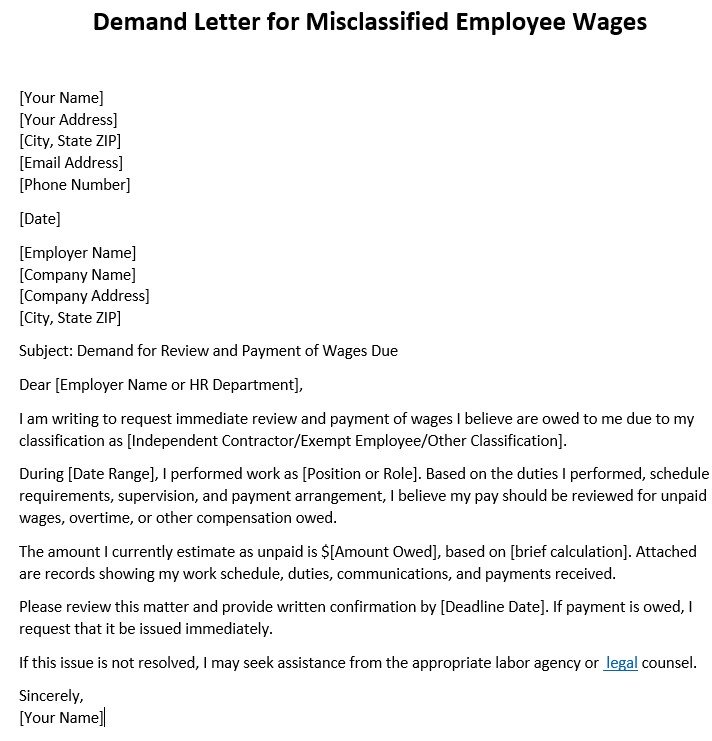
demand letter for misclassified employee wages letter
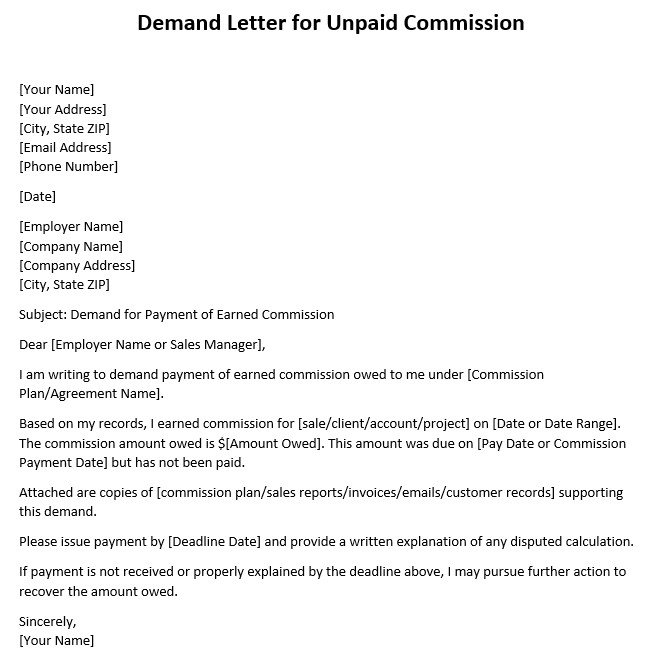
demand letter for unpaid commissions
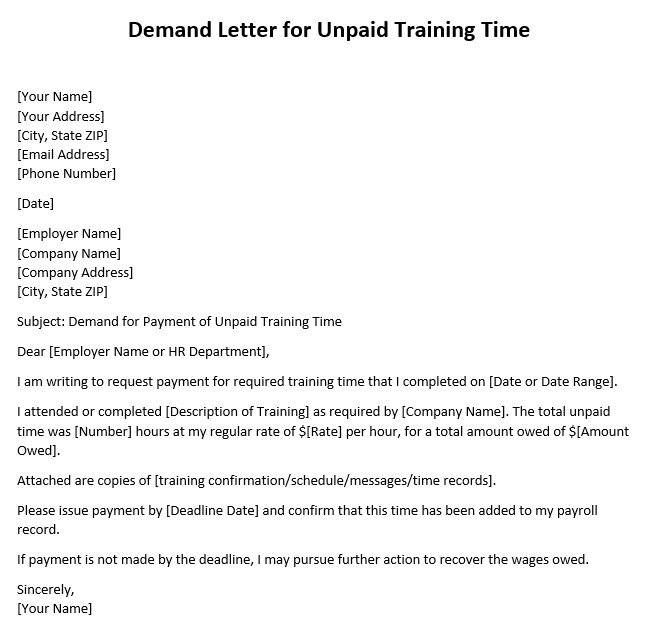
demand letter for unpaid training time letter
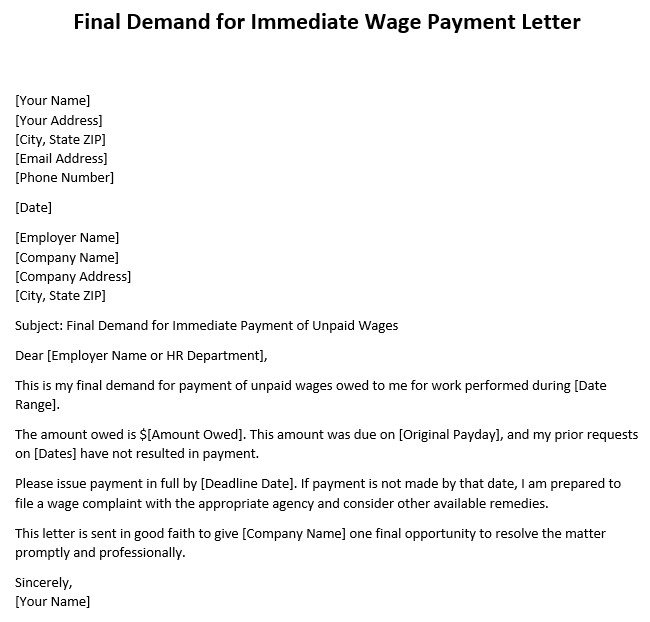
final demand for immediate wage payment letter
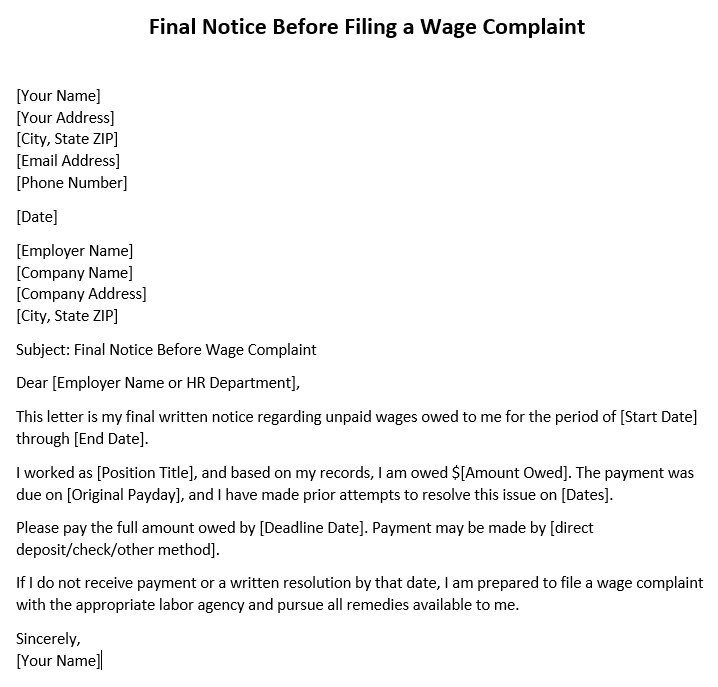
final notice before filing a wage complaint letter
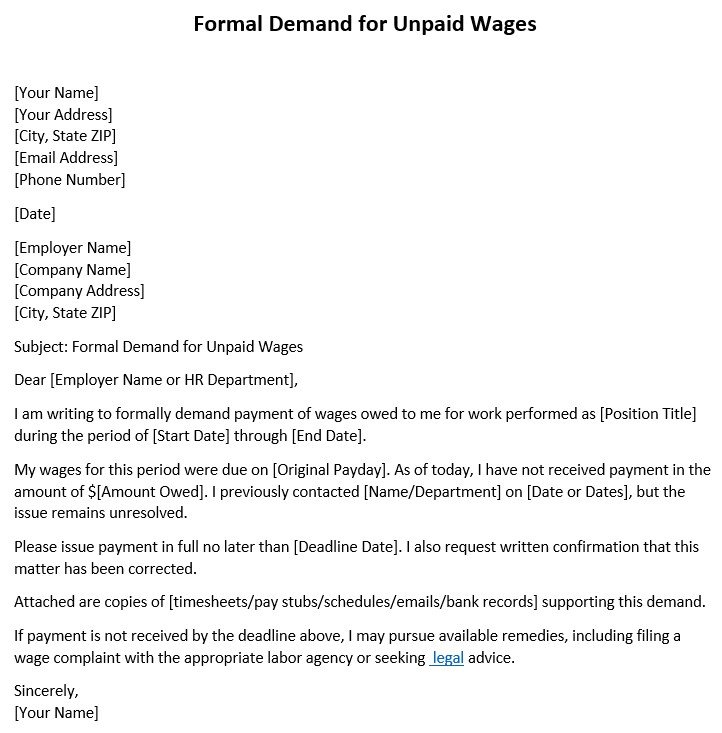
formal demand for unpaid wages letter
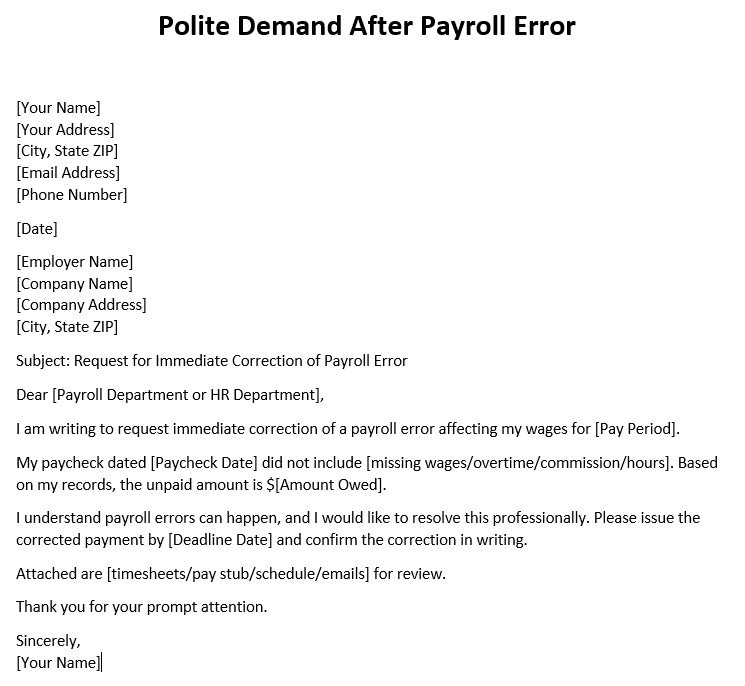
polite demand after payroll error letter
strong demand for repeated nonpayment letter
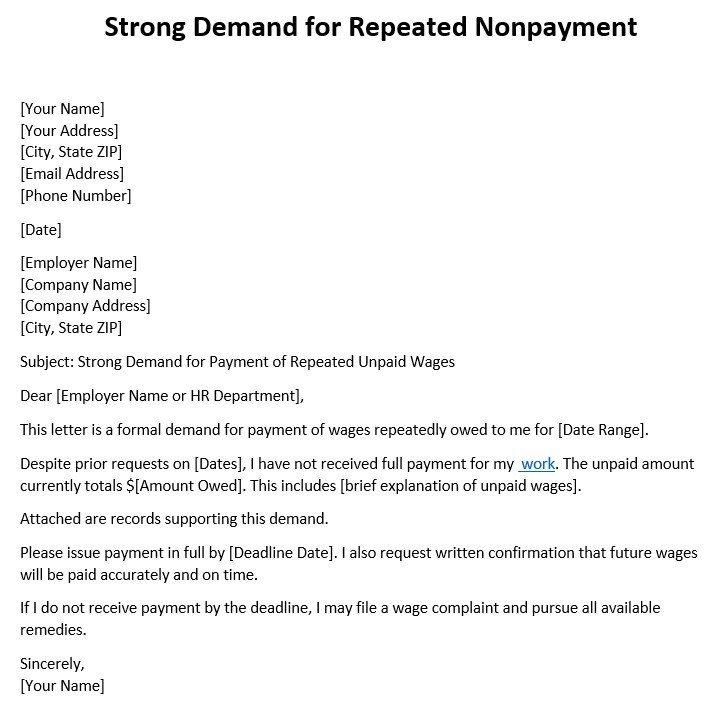
unpaid wages demand letter template
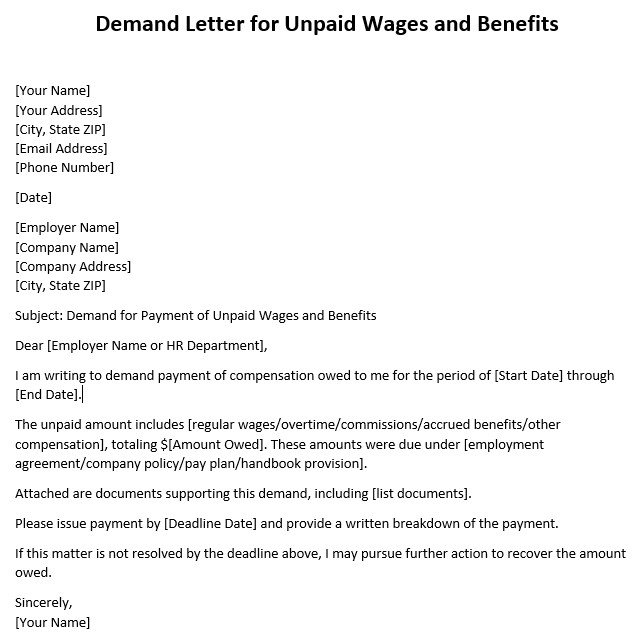
demand letter for unpaid wages and benefits
Frequently Asked Questions:
How to deliver demand for unpaid wages?
Send your unpaid wages demand letter by certified mail. When your employer receives a letter in this way, they have to sign the receipt and send it back to you. Then, you can keep this receipt as proof.
What to do if an employer does not pay the unpaid wages after receiving a demand letter?
File a complaint and summons if an employer still refuses to pay within the time limit you mentioned in the demand letter. This brings them to court and after the court hearing, they have to pay the unpaid wages according to the judge’s order.
What are waiting time penalties?
Every state has its own laws regarding paying an employee their final wages after resigning or being terminated. The law imposes waiting time penalties if an employer doesn’t pay their employee within the specified time. Hence, the employer will have to pay you additional penalties along with the unpaid wages they owe.
How long should I give my employer to pay?
A practical demand may provide seven to ten business days. However, no single response period applies to every wage dispute.
Use a specific calendar date and consider any approaching legal deadline.
Can an employer fire me for asking about unpaid wages?
Federal law prohibits retaliation connected to protected FLSA complaints. State law may provide additional protection.
Record any negative action that happens after your complaint. Contact a labor agency or attorney promptly when retaliation occurs.
What if my employer says I was an independent contractor?
The label used by the company is not always controlling. Worker status depends on the actual relationship and applicable legal test.
Gather your agreement, schedules, instructions, payment records, and information showing how the work was controlled.
Can several employees send one letter?
Workers with the same payroll problem may send individual letters or a joint request. Separate calculations are often helpful because each worker’s hours and pay may differ.
Speak with an attorney or labor agency when the issue affects many workers.
You May also Like
 Free Client Database Template (Excel, PDF)
- Free Notice of Contract Termination Letter Templates (Word)
- Printable Daily Planner Template – 5+ Free Word, Excel, PDF Documents
- Free Editable Projected Income Statement Template
- Free Printable Application Security Checklist Templates (Word / PDF)
- Free Pet Custody Agreement Templates (Word / PDF)