
Creating a professional and accurate reference list can feel confusing, especially when you are unsure which details to include or how to arrange them. A well-designed reference list template makes the process much easier. Instead of starting from a blank page, you can follow a clear format, add the required information, and create a reference list that looks organized and credible.
I have seen students, job seekers, researchers, freelancers, and business professionals struggle with reference lists for different reasons. Some forget important contact information, while others mix citation styles or use inconsistent formatting. In most cases, the problem is not a lack of information. It is the lack of a simple structure.
Table of Contents
What is a reference list?
A reference list is a catalog of all the sources that you used while writing your written document. The main purpose of including this list in your document is that the readers can easily find everything you have cited. Typically it appears at the end of your paper on a separate page. It should be organized alphabetically by the last name of the authors.
Furthermore, you should decide on the citation style to use before coming up with an accurate entry for your reference list. You can use various citation styles such as APA, MLA, and AMA.
What Is a Reference List Template?
A reference list template is a preformatted document that helps you organize the sources or people you want to reference. It provides a consistent structure so that every entry contains the correct information and follows the same style.
The exact meaning of a reference list depends on the situation.
In academic writing, a reference list includes books, journal articles, websites, reports, and other sources cited in an assignment or research paper.
In a job application, a professional reference list includes people who can speak about your skills, work experience, reliability, and character.
In business or project documentation, a reference list may include reports, policies, data sources, industry publications, consultants, or supporting documents.
Although these lists serve different purposes, they all have one goal: helping the reader verify information.
Why reference list is important?
Here are some reasons why you should include this page in your paper;
- Including a reference list in your paper is important so that the reader will have an idea of everything that you have read and used.
- A reference list indicates how much reading or research you’ve done while writing your document. Regardless of what document you are writing, you must indicate that you have done enough research by including the reference list.
- It allows the reader to easily find the sources you have cited in your paper.
- The researchers rely on this page especially when your paper is used as a reference for similar studies and research papers.
- Without adding citations and references, your paper might not seem accurate. The reference list supports your arguments and adds credibility to them.
- Including a reference list indicates that you are sincere about your work and everything that’s written on your paper. Also, it shows that you’ve done all you can to avoid charges of plagiarism.
Why You Should Use a Reference List Template
A template saves time, but that is only one benefit. It also helps you present information in a professional and consistent way.
When I create a reference list without a template, it is easy to miss small details. One entry may include a phone number, while another does not. A source title may be italicized in one place but not in another. These differences make the final document look unfinished.
A reference list template helps you:
- Keep every entry in the same format
- Avoid missing important information
- Follow academic or professional standards
- Make the document easier to read
- Update your references quickly
- Reduce formatting errors
- Create a positive impression
- Make information easier to verify
Templates are especially useful when you need to create several versions of the same list. For example, a job seeker may use different references for different positions. A student may need APA style for one class and MLA style for another.
Key elements of a reference list:
A reference list template usually includes the following elements;
The author’s name
Write the name of the author in this format – last name, comma, first initial then a period. If there is more than one author then add a comma and an ampersand (&) between their names. However, use the title in place of the author’s name if there is no author.
The date of publication
Right after the name of the author, write the date of publication in parentheses. The year of publication is usually enough for most kinds of sources. Additionally, the days and months should be included in the case of magazine and newspaper articles.
The titles
You can either use plain text or italics for formatting the title. Depending on the rules of formatting, the use of capital letters may vary.
The editors
Aside from the author of the publication, if there are editor/s then use the appropriate abbreviation (Ed. or Eds.) after the editor’s last name.
The volume and issue numbers
Don’t use abbreviations when typing the volume and issue numbers. You should only use numbers to list them. Place the issue numbers in parentheses and italicize the volume number.
The page numbers
Only use numbers, not abbreviations to write the page numbers.
The publishers
Write the names of the publisher either the whole name or a shortened version of it.
The retrieval dates
The retrieval date is a must when you have sources taken from the web. Write the word “Retrieved” and the date.
The Web Addresses
Ensure to include the http:// with the web address while referencing web addresses. Use a punctuation mark if you want to fit the address into more than a single line.
How Many Professional References Should You Include?
Most job seekers include three professional references. However, the correct number depends on the employer’s instructions and the seniority of the role.
For an entry-level position, two or three references may be enough. For a senior, technical, academic, or leadership role, an employer may request additional references.
Quality is more important than quantity. A former manager who knows your work well is usually more useful than a senior executive who barely remembers working with you.
Select people who can give specific examples of your performance.
How to Choose the Right Professional References
The best references are people who know your work and can speak positively about your abilities.
Choose someone who can discuss:
- Your job performance
- Technical skills
- Communication ability
- Reliability
- Attendance
- Leadership
- Teamwork
- Problem-solving
- Customer service
- Professional conduct
I recommend matching your references to the role. For example, if you are applying for a project management position, choose someone who can discuss how you managed deadlines, budgets, teams, and client expectations.
For a technical position, select references who understand your technical responsibilities. For a teaching position, use people who can speak about your classroom performance, subject knowledge, and student engagement.
How to format a reference list?
Follow the basic formatting rules to format a reference list;
- Initialize the first name of the author in case the author doesn’t have a middle name.
- According to a new rule, you can include up to 20 authors. For all of the authors, write their last name and first or middle initials.
- Use a comma to separate each of the initials of the authors. Before the name of the last author, use an ampersand. If there are more than 21 authors then after the 19th author, use an ellipsis.
- All entries of the reference list should be alphabetized by the last name of the first author of each work.
- List the entries chronologically (from the earliest to the most recent) for different articles written by a single author or authors organized in the same order.
- Capitalize the first letter of the first word of the title and the subtitle while referencing the titles of chapters, books, articles, webpages, or other sources.
- The titles of short works such as book chapters or edited essay collections shouldn’t be underlined and italicized.
In the case of academic journals, consider the following basic format;
- Italicize the titles of the journal and present them completely.
- The main words of the journal titles should be capitalized. Keep in mind that this may vary from the rule for writing the titles of common sources such as webpages, books, and more.
- When referencing journal articles, capitalize the first word of the titles and subtitles. Additionally, after a dash or colon in the title, you have to capitalize the first word.
- Don’t underline the title of the journal and don’t enclose it in quotes.
sample reference page
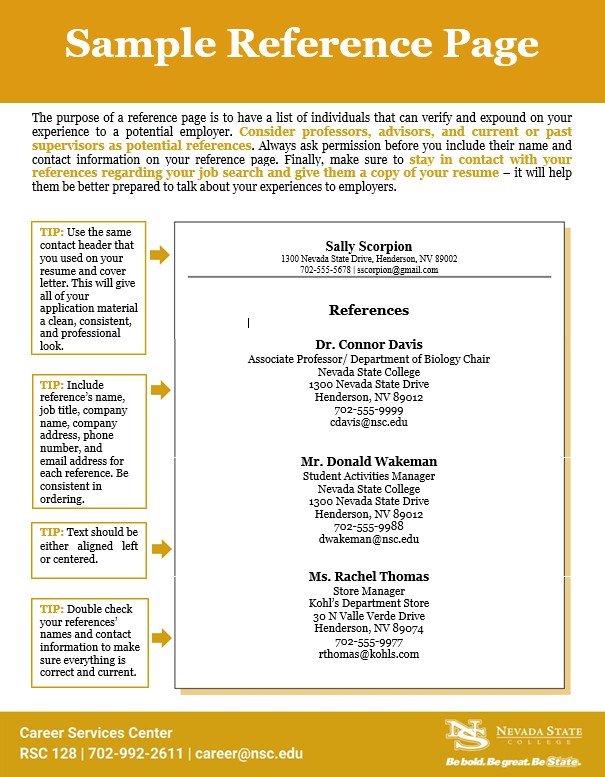
references page template
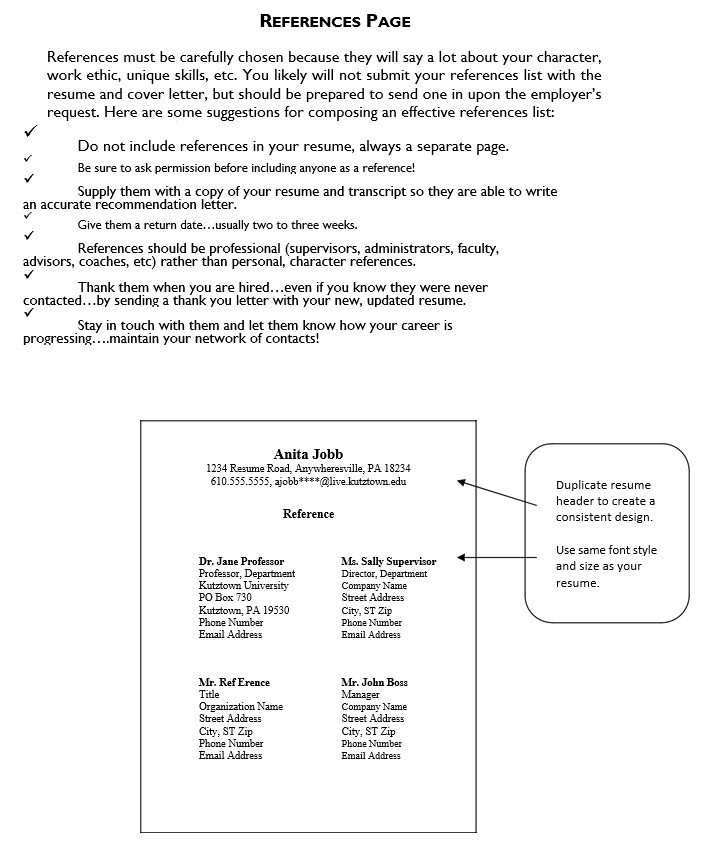
reference sheet outline
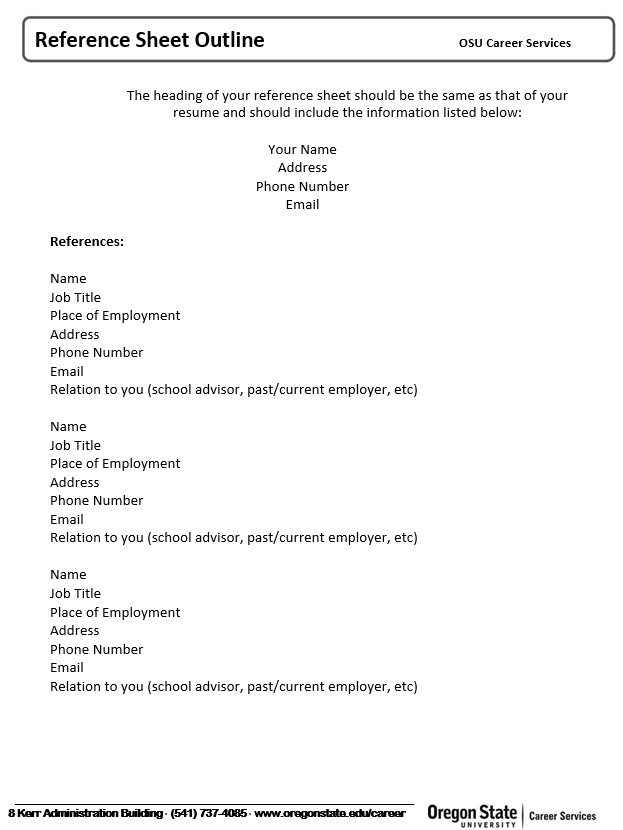
reference list template
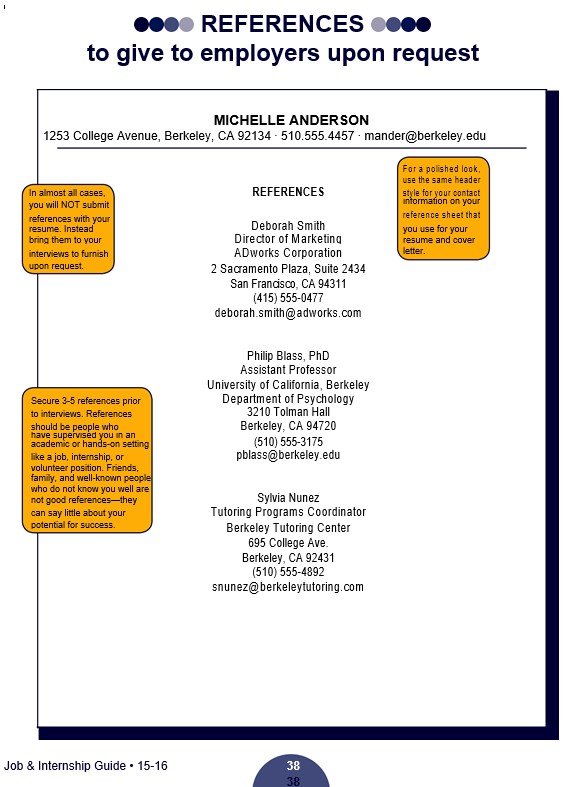
reference list template for job
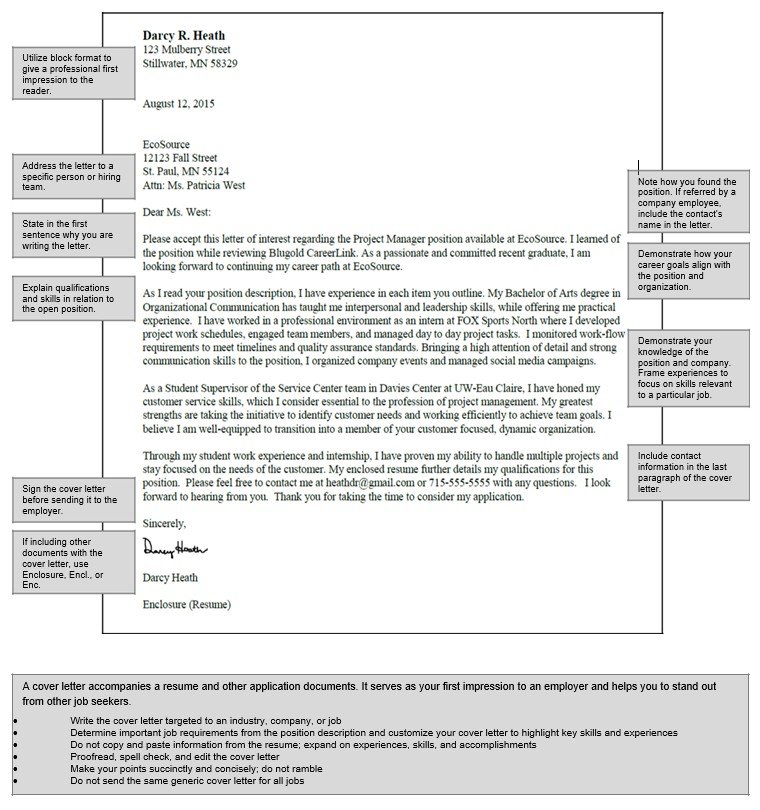
reference list example
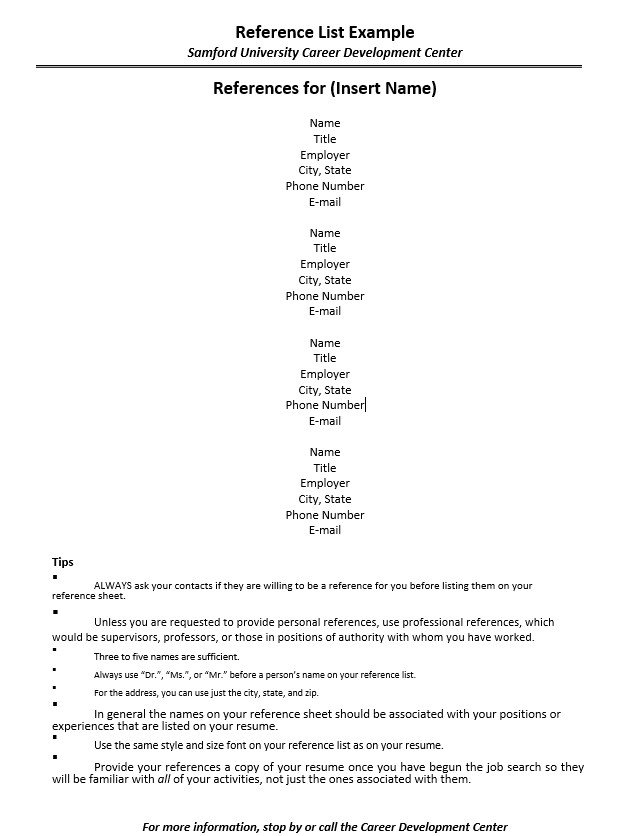
reference letter
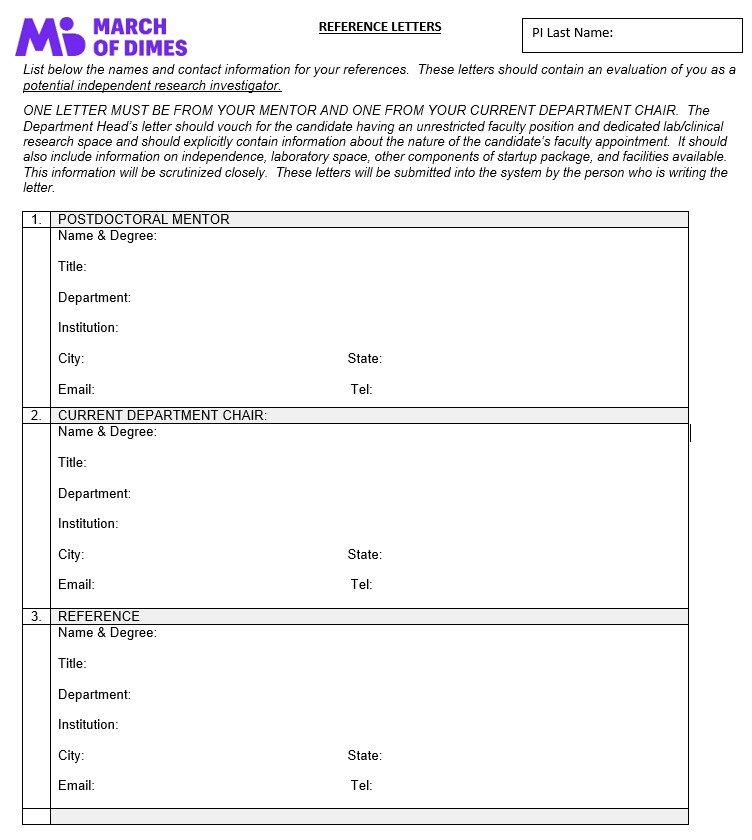
RDC career services for students
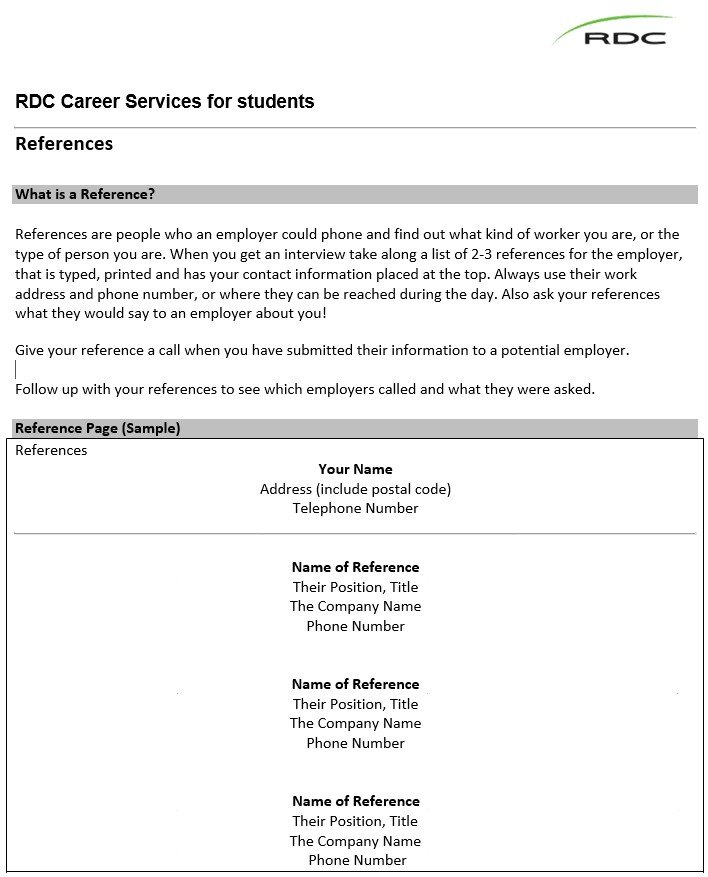
free reference list template

Final Thoughts
A reliable reference list template removes guesswork and gives you a clear system to follow. Whether you are preparing a research paper, applying for a job, submitting a business application, or documenting a project, the most important qualities are accuracy, consistency, relevance, and readability. Start with the right template, verify every detail, and adjust the format to match the instructions you have received.
Frequently Asked Questions About Reference List Templates
How many references should I include in the list?
It would be recommended not to include more references than required.
Can I split references between two pages?
Yes, but you can’t split one entry between two pages.
What should a reference list include?
An academic reference list should include complete details for every source cited in the document. A professional reference list should include the reference’s name, job title, organization, relationship to you, phone number, and email address.
How many references should I list for a job?
Three professional references are common, but you should follow the employer’s instructions. Choose people who know your work and can provide specific examples of your skills.
Can I use the same reference list for every job?
You can maintain one master list, but it is better to select references that match each position. A relevant supervisor or client may provide stronger support for a specific role.
You May also Like
 Free Monthly Timesheet Template (Excel, Word, PDF)
- Free Service Log Template (Excel, PDF)
- Free Printable Pregnancy Verification Form (MS Word)
- Printable Job offer Letter Templates & Samples [MS Word]
- Home Inspection Checklist Template Excel And Word
- 100% Free Tenant Rejection Letter Templates [Word, PDF]
![Printable Job offer Letter Templates & Samples [MS Word]](https://exceltmp.com/wp-content/uploads/2021/12/formal-job-offer-letter-template-150x150.jpg)
![100% Free Tenant Rejection Letter Templates [Word, PDF]](https://exceltmp.com/wp-content/uploads/2021/07/free-tenant-rejection-letter-sample-150x150.jpg)
