
A Singapore payslip template is a ready-made, itemised payslip for employees covered by Singapore’s Employment Act. Since 1 April 2016, every employer in Singapore must give each employee an itemised payslip with every salary payment, or within three working days of it. The payslip must show the 12 items the Ministry of Manpower (MOM) requires, including basic salary, overtime, allowances, deductions, and net pay.
The two free Excel templates below are built for that rule: they calculate CPF contributions, overtime, and net pay with formulas, and they hold every MOM field in the right place. A sample payslip layout and the full 12-item checklist follow, so you can check your own payslips against the official requirements before you download.
Sample Singapore Payslip Layout
This sample shows a November 2026 payslip for an employee aged 55 and below, using the 2026 CPF rates (employee 20%, employer 17%) and the 2026 Ordinary Wage ceiling of S$8,000 a month. Overtime is paid at 1.5 times the hourly basic rate of pay, calculated with MOM’s formula: (12 x monthly basic salary) / (52 x 44).
| Employer Name & UEN | Lion City Tech Pte Ltd (UEN: 201912345K) | Pay Period | 1 Nov 2026 – 30 Nov 2026 |
| Employee Name & ID | Tan Wei Ming (NRIC: SXXXX567A) | Date of Payment | 28 Nov 2026 |
| Basic Salary | S$4,500.00 | Employee CPF (20%) | -S$1,030.80 |
| Transport Allowance | S$300.00 | CDAC Deduction | -S$2.00 |
| Overtime Pay (10 hrs at S$35.40) | S$354.00 | Total Deductions | -S$1,032.80 |
| Gross Pay | S$5,154.00 | Net Pay Payable | S$4,121.20 |
| Employer CPF (17%) | S$876.18 | Mode of Payment | GIRO / Bank Transfer |
CPF is calculated on all Ordinary Wages for the month: basic salary, allowances, and overtime pay together (S$5,154.00), because overtime counts as Ordinary Wages when it is payable by the 14th of the following month. The CDAC deduction of S$2.00 is the rate for total monthly wages above S$5,000 up to S$7,500. Statutory overtime under Part IV of the Employment Act covers workmen earning a basic salary of up to S$4,500 a month and other employees earning up to S$2,600; above those levels, overtime is usually paid under company policy at the same 1.5 times formula. The CPF Board rounds contributions to the nearest dollar in actual payroll submissions, so the figures in your payroll system may differ by a dollar from the exact rates shown here.
MOM Itemised Payslip Checklist: 12 Mandatory Items
MOM requires every itemised payslip to include the 12 items below, unless an item does not apply to that employee. For example, if an employee has no overtime, items 9 to 11 can be left out.
| 1 | Full name of employer |
| 2 | Full name of employee |
| 3 | Date of payment (or dates, if the payslip covers multiple payments) |
| 4 | Basic salary (for hourly, daily, or piece-rated workers: the basic rate of pay and the total hours, days, or pieces worked) |
| 5 | Start and end date of salary period |
| 6 | Allowances paid for the salary period (all fixed allowances, such as transport, and all ad-hoc allowances, such as a one-off uniform allowance) |
| 7 | Any other additional payment for the salary period (bonuses, rest day pay, public holiday pay) |
| 8 | Deductions made for the salary period (all fixed deductions, such as the employee’s CPF contribution, and all ad-hoc deductions, such as no-pay leave) |
| 9 | Overtime hours worked |
| 10 | Overtime pay |
| 11 | Start and end date of overtime payment period (if different from item 5) |
| 12 | Net salary paid in total |
The employer’s CPF contribution is not one of the 12 mandatory items, but the Tripartite Guidelines recommend showing it on the payslip for transparency, and both templates below include it. Payslips can be soft copy, hard copy, or handwritten, and employers must keep a record of all payslips issued: the latest two years for current employees, and for ex-employees the last two years kept for one year after they leave.
Why Do You Need a Payslip Template in Singapore?
A payslip is proof of income and a breakdown of how salary is calculated. It benefits both employers and employees in several ways: legal compliance, because MOM requires itemised payslips under the Employment Act; transparency, because it shows a clear breakdown of earnings, deductions, and contributions; proof of income, which employees need for bank loans, visa applications, and financial checks; and payroll efficiency, because a standard template saves the HR and finance team from rebuilding the same document every month. A template also keeps every payslip in the same format, which makes audits and salary disputes much easier to resolve.
Essential Components of a Singapore Payslip Template
A professional Singapore payslip template should include the following:
1. Company & Employee Details
Company name, UEN, and address, plus the employee’s name, designation, employee ID, and pay period. These are the same header details that appear on your company profile template, and they must match the employer’s registered details.
2. Earnings
Basic salary, overtime (OT) pay, allowances (transport, meal, housing), and bonuses, incentives, or commissions. Each line is shown separately so the employee can see exactly how gross pay is built up.
3. Deductions
Employee CPF contribution (based on official CPF rates), income tax withheld (if applicable), self-help group contributions such as CDAC, SINDA, MBMF, or ECF, and other deductions (insurance, salary advances, no-pay leave).
4. Employer Contributions
Employer CPF contribution, shown for information even though it is not deducted from the employee’s pay, plus any additional company-paid benefits the employer wants to record.
5. Net Pay
Final take-home pay after all deductions: gross pay minus total deductions. This is the amount the employee actually receives, and it must match the bank transfer or cash payment.
6. Year-to-Date Summary (Optional)
Monthly accumulation of earnings, CPF, and deductions for record-keeping. The main template below includes a year-to-date sheet, which is useful at year end and for IRAS reporting.
How CPF Is Calculated on a Singapore Payslip
For Singapore Citizens and Permanent Residents (from their third year of PR status) aged 55 and below earning more than S$750 a month, the 2026 CPF rates are 20% from the employee and 17% from the employer, a total of 37%. CPF is calculated on Ordinary Wages (OW): basic salary, allowances, overtime pay, and commissions for the month. From 1 January 2026, the Ordinary Wage ceiling is S$8,000 a month, so wages above that do not attract CPF on the Ordinary Wage side. A separate annual salary ceiling of S$102,000 applies to bonuses and other Additional Wages.
The formulas the templates use are: Employee CPF = MIN(Ordinary Wages, 8000) x 20% and Employer CPF = MIN(Ordinary Wages, 8000) x 17%. Overtime counts as Ordinary Wages when it is payable by the 14th of the following month; overtime paid later counts as Additional Wages instead. Self-help group deductions are separate from CPF: CDAC, SINDA, MBMF, and ECF contributions are small fixed monthly amounts set by wage band (for example, CDAC is S$2.00 a month for total wages above S$5,000 up to S$7,500), deducted from the employee’s pay and remitted through the CPF Board. For a detailed monthly pay breakdown outside Singapore, see our salary breakdown Excel template.
Benefits of Using a Singapore Payslip Template
A ready-made template saves time by automating CPF and net pay calculations, so payroll takes minutes instead of hours. It reduces errors, because the formulas do the arithmetic and the ceiling is applied the same way every month. It looks professional: a clean, branded payslip builds trust with employees and with banks that ask for proof of income. And it is flexible: the same template works for full-time, part-time, and contract staff, with rates and allowances adjusted per employee.
Best Practices for Payroll Compliance in Singapore
To avoid penalties and disputes, employers should update CPF rates and salary ceilings whenever the CPF Board announces a change, and always state the pay date and pay period clearly on every payslip. Issue the payslip together with the salary payment, or within three working days of it, even for electronic salary transfers. Keep payslip records for at least two years for current employees, and for one year after an ex-employee leaves. Finally, check each payslip against the 12-item MOM checklist above before sending it: a missing line, such as overtime hours or the salary period dates, is the most common reason a payslip fails a MOM check.
Download a Free Singapore Payslip Template
Download either template below. Both are Excel files with working formulas; change the company details, rates, and earnings, and the CPF, deductions, and net pay update automatically.
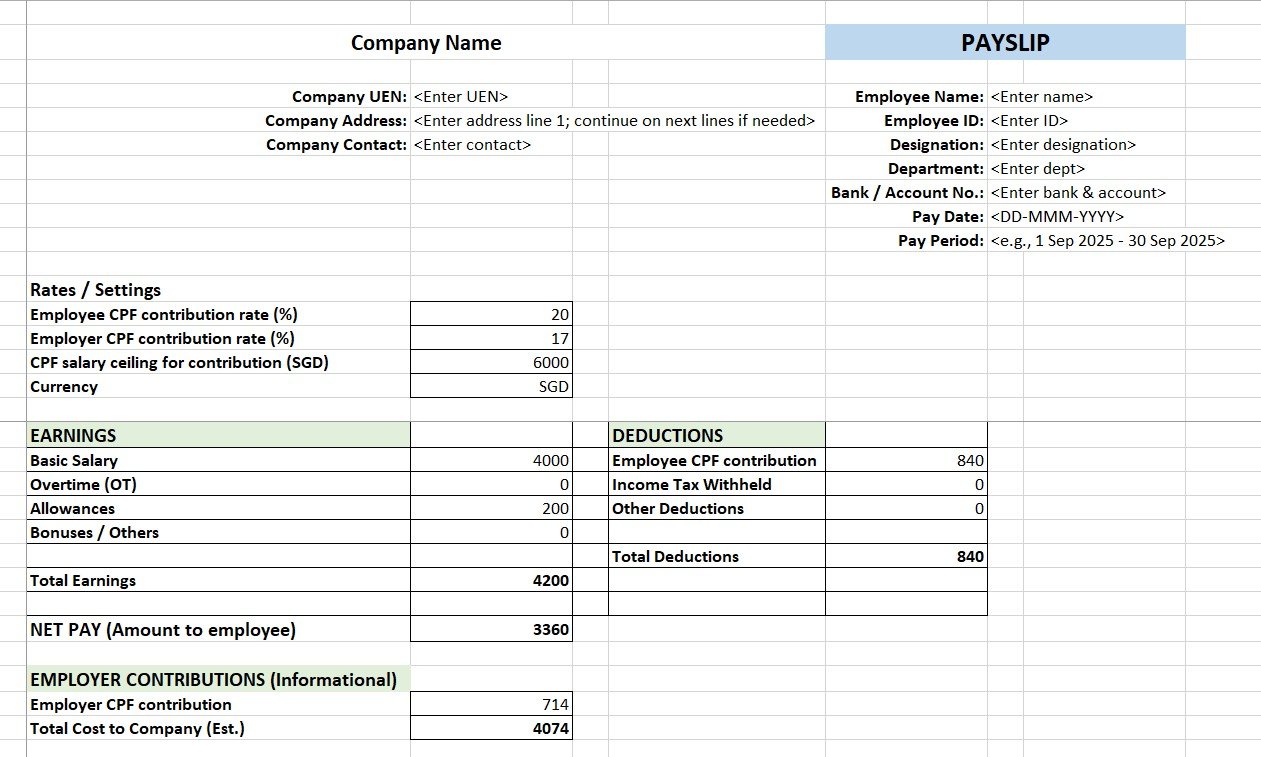
Singapore Payslip Template (Excel)
A three-sheet workbook (Payslip, Year-to-date, Instructions) with editable settings for the employee CPF rate, employer CPF rate, and CPF salary ceiling. It calculates employee and employer CPF, total deductions, net pay, and total cost to company, and the year-to-date sheet tracks every month’s earnings and CPF.
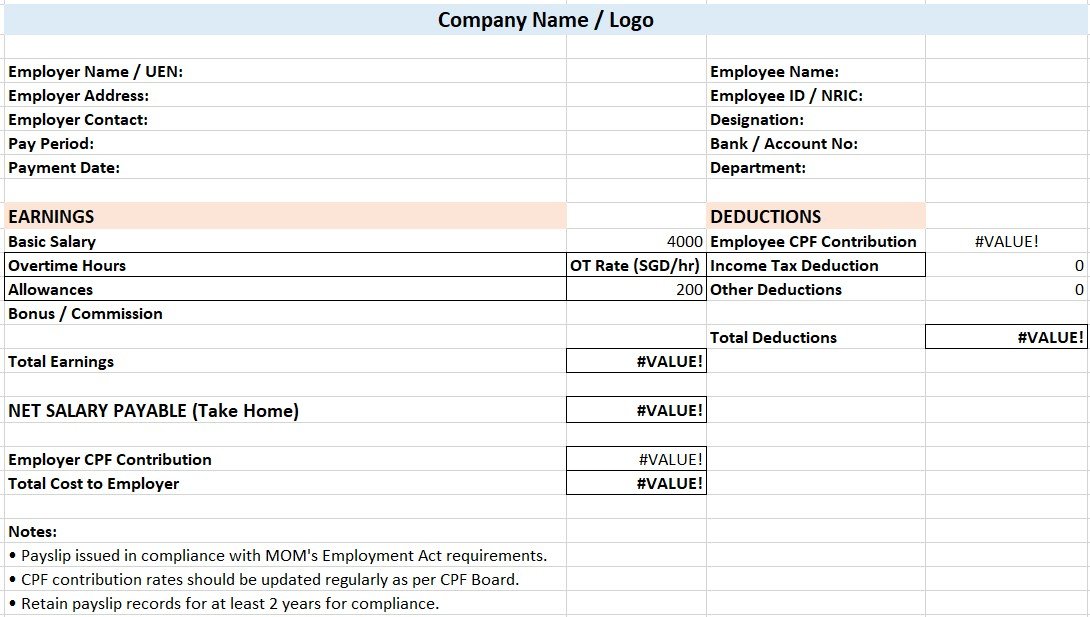
Singapore MOM Payslip Template (Excel)
A single-sheet MOM-layout payslip with earnings and deductions side by side, overtime pay, allowances, and bonuses on one side and CPF, income tax, and other deductions on the other. It calculates total earnings, net salary payable, employer CPF, and total cost to employer, with compliance notes on the sheet.
Managing payroll for international staff or looking for a non-CPF layout? Explore our main Free Payslip Template hub for editable Word, Excel, and PDF formats.
Frequently Asked Questions
Is it mandatory to issue payslips in Singapore?
Yes. Under the Employment Act, all employers in Singapore must issue itemised payslips to employees covered by the Act. Payslips can be in hard copy or electronic format, and employers must keep records for at least two years for current employees.
What should be included in a Singapore payslip?
A compliant payslip must show the 12 items MOM requires: employer and employee full names, payment date, basic salary, salary period dates, allowances, other additional payments, deductions, overtime hours, overtime pay, overtime period dates (if different), and net salary paid. Employer CPF contribution is recommended for transparency but is not one of the 12 mandatory items.
How do I calculate CPF contributions on a payslip?
CPF is calculated on Ordinary Wages (basic salary, allowances, and overtime) up to the S$8,000 monthly ceiling from 1 January 2026. For employees aged 55 and below, the employee contributes 20% and the employer 17%. The employee’s share is deducted from gross salary; the employer’s share is paid by the company on top of salary.
Can I use Excel to create payslips in Singapore?
Yes. Excel is a popular choice for small and medium businesses. A Singapore payslip template in Excel can include formulas that automatically calculate CPF, net salary, and deductions, which reduces manual errors and keeps every payslip in the same compliant format.
How long must employers keep payslip records in Singapore?
Employers must keep payslip records for the latest two years for current employees. For ex-employees, the last two years of records must be kept for one year after the employee leaves. Keeping records protects both employer and employee during audits and disputes.
