
A service agreement template is one of the most useful documents you can have when offering professional services or hiring someone to complete a project. Whether you are a freelancer, consultant, agency owner, small business operator, contractor, or client, a written service agreement helps everyone understand what is expected before the work begins.
I have seen many business relationships start with excitement and confidence, only to become stressful because the important details were never written down. One person expected unlimited revisions, while the other believed the project included only two. A client thought the payment was due after completion, while the service provider expected an advance payment.
Most of these problems can be avoided with a clear service agreement.
Table of Contents
What is a service agreement?
A service agreement is a contract between the service provider and a client. It specifies the exchange of services for compensation. This agreement comes in handy when you offer any kind of service to a new client. Moreover, it describes the following details;
- The terms of service
- A description of the work
- The price for the service
- The contact details of the contractor and the client
When a job’s terms become more complicated or require a detailed explanation then a service agreement becomes necessary. Some other names of this agreement are;
- General Service Contract
- Independent Contractor Agreement
- Consulting Services Agreement
What Is a Service Agreement Template?
A service agreement template is a reusable document that contains the standard structure and clauses needed for a professional service contract.
Instead of writing a completely new agreement every time you work with a client, you can use a template and update the details for each project.
A template usually includes blank spaces or editable sections for:
- Names of the parties
- Business information
- Description of services
- Project dates
- Fees and payment schedules
- Deliverables
- Revision limits
- Intellectual property terms
- Confidentiality conditions
- Cancellation rules
- Signatures
Using a template saves time, creates consistency, and reduces the risk of forgetting an important contract term.
However, a service agreement template should not be copied and used without reviewing it. Every project is different, so the wording must be adjusted to match the actual services, risks, payment arrangement, and legal requirements involved.
What kind of businesses requires a service agreement?
Here are many kinds of businesses that use a service agreement while entering into business relationships with clients;
- Catering contract
- Daycare contract
- Flooring contract
- Handyman contract
- Home improvement contract
- Interior design contract
- Landscaping contract template
- Modeling contract template
- Photography contract template
- Plumbing contract
- Roofing contract
- Snow removal contract
- Videography contract
Aside from the above-mentioned services, there are so many other kinds of services that require a service agreement template.
Who should use a service agreement?
A service agreement template can be useful for almost anyone who provides or purchases professional services.
Freelancers
Freelancers can use service agreements for writing, design, development, consulting, editing, photography, video production, social media management, and many other services.
A freelance service agreement should clearly address deadlines, payment milestones, revision limits, portfolio rights, and ownership of the final work.
Consultants
Consultants often provide advice, strategy, research, planning, or specialized expertise.
Their agreements may need to clarify that recommendations do not guarantee a specific financial, legal, marketing, or operational result.
Agencies
Agencies commonly provide multiple services under one contract.
An agency service agreement may cover:
- Marketing campaigns
- Advertising management
- SEO
- Website maintenance
- Branding
- Content production
- Lead generation
- Public relations
- Analytics and reporting
Agency contracts should clearly define what is included in the monthly fee and which third-party expenses are billed separately.
Independent Contractors
Contractors providing maintenance, repair, installation, construction, cleaning, landscaping, or technical services can use an agreement to define labor, materials, warranties, safety responsibilities, and access requirements.
Small Businesses
A small business may use service agreements when hiring outside professionals for accounting, IT support, cleaning, legal assistance, design, consulting, or marketing.
Clients Hiring Service Providers
Clients should also request written agreements. A contract gives the client evidence of the provider’s promises and establishes a process for delays, changes, and incomplete work.
When to use a written service agreement?
Any time when service providers perform a service for a client, they should use a service agreement. The agreement allows the service provider to record the pay rate for services, invoicing frequency, and insurance clauses. Thus, it makes sure that they receive compensation and protects their interests.
When clients hire a service provider to perform a paid task, they should use a service agreement. The agreement provides them the exact details of the arrangement.
What to include in a service contract?
Let us discuss below the main components of a service contract;
Services
In this section, provide details of all of the services you’ll be performing for your client. Try to indicate to your client what they will get from your business. You have to understand the scope of the job in order to list your services accurately. To determine your client’s goals, ask quality questions and listen to them attentively.
Payment terms
Here, you have to state clearly how much you charge and when you expect to be paid. This serves as an invoice for your clients that you perform their work on the basis of a fixed fee or hourly rate. After sending the invoice to your client, consider when you expect to be paid. So, you should clearly state everything in your contract.
Start date
Your client always wants to know when you can start the project. It is important to keep the right balance between your availability and the client’s requirements while deciding on a start date. Therefore, before drafting the contract, ask the client when they hope to complete the job.
Termination
Every party has to agree on the terms of termination in your contract. This is because sometimes parties want to part away for some reason.
Signatures
Consent from all parties is required to make the contract legally binding. Signatures serve as legal proof because they indicate both clients and service providers accept the terms of a service agreement.
Essential Elements of a Service Agreement Template
A service agreement template should cover the complete working relationship. The following sections are among the most important.
Names and Contact Details of the Parties
The agreement should identify everyone involved.
Include the full legal name, business name, address, email address, and other relevant contact information for both the service provider and the client.
For example:
“This Service Agreement is entered into between BrightPath Marketing LLC, referred to as the ‘Service Provider,’ and Green Valley Furniture Inc., referred to as the ‘Client.’”
Using defined terms such as “Service Provider” and “Client” makes the rest of the document easier to read.
Effective Date
The effective date is the date on which the agreement begins.
- The date the agreement is signed
- The first day of the project
- A specific future date
- The date the first payment is received
The agreement should clearly state when its terms become active.
Description of Services
This is one of the most important sections of the entire agreement.
Avoid vague wording such as:
“The provider will help with marketing.”
Instead, write a detailed description such as:
“The Service Provider will conduct keyword research, optimize ten website pages, prepare four blog articles per month, monitor technical SEO issues, and deliver a monthly performance report.”
The more specific this section is, the easier it becomes to manage expectations.
Deliverables
Deliverables are the items or outcomes the service provider must provide.
Examples include:
- A completed website
- A written report
- Ten edited photographs
- Four monthly articles
- A logo package
- A marketing strategy
- A software prototype
- A maintenance inspection
- A training session
Each deliverable should be described clearly. Where possible, include quantity, format, length, size, platform, or technical specifications.
Project Timeline
The timeline section explains when the work will begin and when it should be completed.
You may include:
- Project start date
- Final completion date
- Milestone dates
- Review periods
- Client feedback deadlines
- Estimated delivery times
Some projects depend on the client providing information, approvals, passwords, images, or other materials. The agreement should explain that delays in client cooperation may extend the delivery schedule.
Fees and Payment Terms
The payment clause should be easy to understand.
State whether the client will pay:
- A fixed project fee
- An hourly rate
- A daily rate
- A monthly retainer
- A milestone-based fee
- A commission
- A performance-based amount
Also include the currency, tax responsibilities, invoice schedule, payment due date, and accepted payment methods.
A common arrangement is a 50% deposit before work begins and the remaining 50% before final delivery. Larger projects may use several milestone payments.
Late Payment Terms
A service agreement should explain what happens when payment is late.
Possible terms may include:
- A late fee
- Interest on overdue balances
- Suspension of services
- Delayed delivery
- Withholding of final files
- Recovery of collection expenses
The terms should be reasonable and comply with applicable laws.
Expenses and Third-Party Costs
Some projects require additional purchases, such as:
- Software subscriptions
- Stock photographs
- Advertising costs
- Travel expenses
- Printing
- Hosting
- Domain registration
- Materials
- Equipment rental
- Delivery charges
The agreement should state whether these expenses are included in the service fee or charged separately.
It should also explain whether the client’s approval is required before the provider incurs an additional expense.
Revisions and Change Requests
Revision limits are especially important for design, writing, web development, consulting, and creative work.
The agreement may include two rounds of reasonable revisions. Additional revisions can then be billed at a stated hourly rate.
It is also helpful to define the difference between a revision and a new request.
Changing the color of a design may be a revision. Requesting a completely different design concept may be outside the original scope.
Client Responsibilities
A successful project usually requires cooperation from both sides.
The client may be responsible for:
- Providing accurate information
- Supplying content or images
- Giving access to systems
- Reviewing work on time
- Approving deliverables
- Making payments
- Obtaining internal permissions
- Ensuring submitted materials do not violate third-party rights
Clearly describing these responsibilities reduces avoidable delays.
Confidentiality
During a project, the parties may share sensitive information, including:
- Customer lists
- Business plans
- Login details
- Pricing information
- Financial records
- Marketing strategies
- Product ideas
- Internal documents
- Trade secrets
A confidentiality clause states that private information must not be disclosed or used for an unauthorized purpose.
The clause may also explain what information is not considered confidential, such as information already available to the public.
Intellectual Property Ownership
Intellectual property terms determine who owns the work created during the project.
The agreement should address:
- Ownership of final deliverables
- Ownership of drafts and unused concepts
- Transfer of rights after full payment
- Use of pre-existing materials
- Third-party licenses
- Portfolio display rights
- Open-source or licensed assets
For many creative projects, ownership of the final approved work transfers to the client after full payment. The service provider may retain ownership of drafts, methods, templates, tools, or unused concepts.
The correct arrangement will depend on the project.
Independent Contractor Relationship
This clause explains that the service provider is working as an independent contractor rather than as an employee.
It may state that the provider is responsible for their own taxes, insurance, equipment, working methods, and business expenses.
This section can help distinguish an independent service relationship from employment, although the actual legal classification usually depends on the real working arrangement, not only the contract wording.
Warranties and Disclaimers
A warranty is a promise about the service or deliverable.
For example, a provider may promise that the work will be original or completed with reasonable professional care.
However, service providers often avoid guaranteeing results that depend on external factors.
A marketing consultant may provide strategy and campaign management but cannot guarantee a specific number of sales. An SEO provider cannot guarantee a number-one Google ranking. A business consultant cannot guarantee future profits.
The agreement should distinguish between what the provider controls and what the provider cannot guarantee.
Limitation of Liability
A limitation of liability clause may restrict the amount or type of damages one party can claim.
For example, the agreement may limit the service provider’s total liability to the amount paid under the contract.
This is an important legal section and may not be enforceable in every situation. Its wording should be reviewed carefully for the laws that apply to the agreement.
Indemnification
An indemnification clause explains when one party must protect or reimburse the other for certain claims, losses, or expenses.
For example, the client may confirm that content supplied to the provider does not infringe another person’s copyright. If that content leads to a claim, the agreement may assign responsibility to the client.
Because indemnity clauses can create significant legal obligations, professional legal review may be appropriate.
Term and Renewal
The term explains how long the agreement will remain in effect.
It may continue:
- Until a project is completed
- For three months
- For one year
- On a month-to-month basis
- Until either party ends it
For recurring services, the agreement should explain whether it renews automatically and how much notice is required to prevent renewal.
Termination
The termination section explains how the working relationship can end.
It should cover:
- Termination by either party
- Required notice
- Termination for breach
- Immediate termination conditions
- Payment for completed work
- Treatment of deposits
- Return of confidential information
- Delivery of partially completed work
A fair termination clause gives both parties a clear exit process.
Force Majeure
A force majeure clause addresses serious events outside the parties’ reasonable control, such as natural disasters, major outages, government restrictions, war, or widespread emergencies.
The clause may allow deadlines to be extended or obligations to be suspended while the event continues.
Dispute Resolution and Governing Law
The agreement should explain how disputes will be handled.
Possible methods include:
- Direct negotiation
- Mediation
- Arbitration
- Court proceedings
It should also identify which state, province, or country’s laws govern the contract.
These terms can have major consequences, especially when the parties are located in different regions.
Signatures
Both parties should sign and date the agreement.
Electronic signatures are commonly used for service contracts, depending on applicable law and the nature of the transaction.
The signature section may include:
- Full name
- Title
- Company name
- Signature
- Date
Sample Service Agreement Template:
The following basic service agreement template can be adapted for general business use.
Service Agreement
This Service Agreement is entered into on [Effective Date] between:
Service Provider:
[Full Legal Name or Business Name]
[Address]
[Email Address]
and
Client:
[Full Legal Name or Business Name]
[Address]
[Email Address]
1. Services
The Service Provider agrees to perform the following services:
[Describe the services in detail.]
The Service Provider will deliver the following items:
[List all deliverables, quantities, formats, and specifications.]
2. Project Schedule
The services will begin on [Start Date].
The estimated completion date is [Completion Date].
The Client agrees to provide all required information, materials, approvals, and access within the agreed timeframes. Delays caused by the Client may result in an extension of the project schedule.
3. Fees
The Client agrees to pay the Service Provider a total fee of [Amount and Currency].
The payment schedule will be as follows:
- [Amount or percentage] due before work begins
- [Amount or percentage] due on [Milestone or Date]
- Remaining balance due before final delivery
Invoices must be paid within [Number] days.
4. Additional Services
Services outside the agreed scope will require written approval and may be charged at [Hourly Rate] or under a separate quotation.
5. Expenses
[State whether expenses are included.]
Any additional expense above [Amount] must be approved by the Client before it is incurred.
6. Revisions
The service fee includes [Number] rounds of revisions.
Additional revisions or major changes to the approved direction will be billed at [Rate].
7. Client Responsibilities
The Client agrees to provide accurate information, timely feedback, necessary access, and all materials required to complete the services.
The Client confirms that it has the right to use all content and materials supplied to the Service Provider.
8. Confidentiality
Each party agrees to protect confidential information received from the other party and to use such information only for the purposes of completing this agreement.
9. Intellectual Property
Upon receipt of full payment, ownership of the final approved deliverables will [transfer to the Client/remain with the Service Provider/be licensed to the Client].
The Service Provider retains ownership of pre-existing tools, templates, systems, methods, drafts, and unused concepts unless otherwise stated in writing.
10. Independent Contractor
The Service Provider is an independent contractor and not an employee, partner, or agent of the Client.
11. No Guarantee of Results
The Service Provider will perform the services with reasonable professional care but does not guarantee specific financial, commercial, ranking, traffic, sales, or performance results unless expressly stated in this agreement.
12. Termination
Either party may terminate this agreement by providing [Number] days’ written notice.
The Client must pay for all services completed and approved expenses incurred up to the termination date.
The treatment of deposits and partially completed work will be as follows:
[Insert applicable terms.]
13. Limitation of Liability
To the extent permitted by law, the Service Provider’s total liability under this agreement will not exceed [Amount or Total Fees Paid].
14. Governing Law
This agreement will be governed by the laws of [State, Province, or Country].
Any dispute will first be addressed through good-faith negotiation. If the dispute cannot be resolved, it will be handled through [Mediation, Arbitration, or Courts] in [Location].
15. Entire Agreement
This document represents the complete agreement between the parties regarding the services described above. Any changes must be made in writing and accepted by both parties.
Service Provider
Name: __________________________
Signature: ______________________
Date: __________________________
Client
Name: __________________________
Signature: ______________________
Date: __________________________
Difference between a contract and a service agreement:
There is a small difference between these two documents. The outline of a contract is more formal than a service agreement. The contract includes many other forms of potential misunderstanding. Also, it often comes along with the service agreement.
On the other hand, a service agreement describes the services that are being provided in detail. Most businesses before signing the contract, set up and develop a service agreement with their clients. This makes sure that all the parties that are involved in the contract are clear about what services are being offered. It is very helpful to develop this agreement for many reasons. Also, it makes sure that both parties will sign the contract that they feel they can uphold.
A contract states how the relationship can be terminated and it also takes care of all the legal disclosures that are relevant to doing business in your state or county.
How to write a service agreement?
Consider the following steps to write a service agreement;
Specify how long the services are required
In your service agreement, explain how long the contractor will have to provide the service. This agreement can be for a single job, a fixed term, and indefinitely.
Mention the state where the work is taking place
Every state has labor laws that may vary from others. So, you have to mention the state where the work is taking place. Federal labor laws are usually governed by the Fair Labor Standards Act. According to the Service Contract Act of 1965, service providers have to pay their employees minimum wage for any contract in excess of $2,500.
Explain the service being provided
For the length of the agreement, provide a description that states what the service provider will do. This helps to reduce the risk of misunderstandings later. The contractor and the client get a clear idea of what to expect by having an accurate description of services.
Give the details of the contractor and client
Provide the names, addresses, and contact details of the contractor and the client. Also, you need to specify whether each party is an individual or organization. In your document, indicate as many as four contractors or clients. Additionally, including these details in the service agreement serve as a convenient reference for the parties if they want to contact the other.
Outline the compensation
Consider the following factors to decide how compensation will be exchanged;
- Pay rate
- Sale tax
- Payment schedule
- Interest for late payments
- Consequences of non-performance
Billing details: include in the agreement the amount of money that the contractor will make for the service. Specify the payment amount and the rate the service provider will charge. Explain the compensation in case the contractor and client agree on a different payment method.
Deposit: if a deposit is part of your agreement then mention the deposit amount. A sum of money that the client provides the contractor before work starts to refer to as a deposit. For the delivery of a service, it serves as security or collateral. A deposit is usually 10 to 50% of the total contract amount on the basis of the client’s trustworthiness and financial stability.
Payment schedule: state the specific time when the client will make payments to the contractor. However, it depends on the duration of your contract. Depending on the completion of various stages of the work, the higher-value construction contracts have a customized payment schedule. Periodic invoicing and payments are typically featured by open-ended contracts having no fixed dates.
Late payments: mention the specific time frame when the client has to pay the service provider after getting an invoice. A time period of 15 to 30 days is usually enough to pay an invoice. The contractor can apply an interest rate on late payments in case the customer doesn’t pay the amount they owe within the time frame.
State the terms of the agreement
The terms and conditions of the working relationship between a contractor and a customer must be covered in the agreement.
- Reimbursing expenses: to keep a project progressing, there are some instances where the contractor has to dip into their pocket. In the agreement, indicate whether the client will have to reimburse the contract for work-relevant expenses. If yes then mention the instructions for additional costs.
- Intellectual property: any work that is a creation of the mind is referred to as intellectual property. Sometimes when performing a job, a contractor has to get innovative. The intellectual property which is built during the service between the contractor and client, specifies who will own it.
- Confidentiality: include the terms that address confidentiality. It depends on the client’s preferences whether they want to include these clauses to protect sensitive information regarding themselves or their business.
Add any additional clauses
This section is usually used to address the following factors;
- Indemnity
- Return of property
- Liability
- Legal expenses
However, it is optional to add these terms on the basis of your personal situation.
Explain the signing information
You must state in the agreement when the parties will sign the service agreement. You can provide the date later if you don’t know when the parties will sign the document.
Final Thoughts
A well-written service agreement template creates clarity before a project begins. It helps the service provider explain exactly what will be delivered and gives the client confidence that the work, price, and timeline have been properly documented.
The most effective agreements are not necessarily the longest or most complicated. They are the ones that accurately describe the real working relationship.
Before sending your next proposal or starting a new client project, take time to define the scope, deliverables, payment terms, revision process, ownership rights, and termination conditions. A few extra minutes spent preparing the agreement can prevent hours of confusion later.
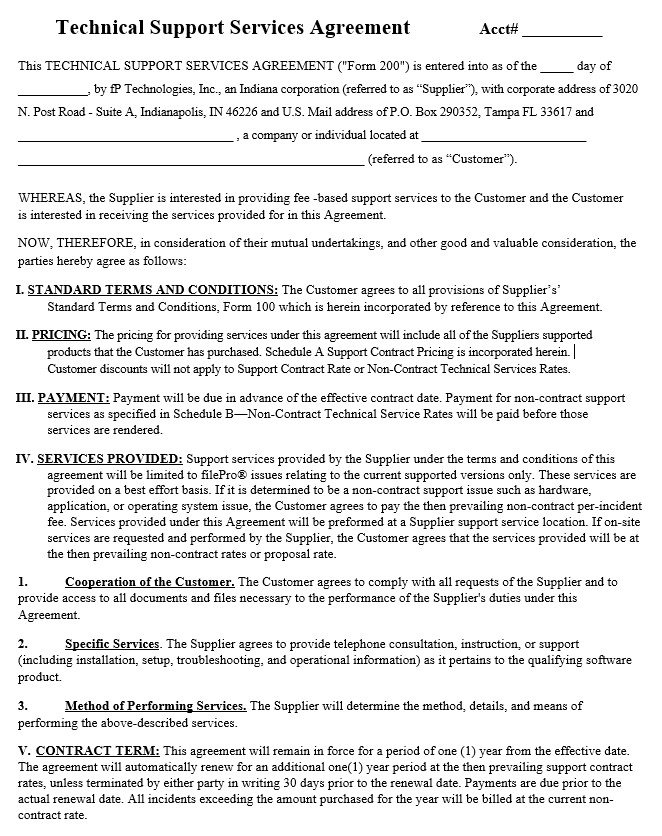
technical support services agreement
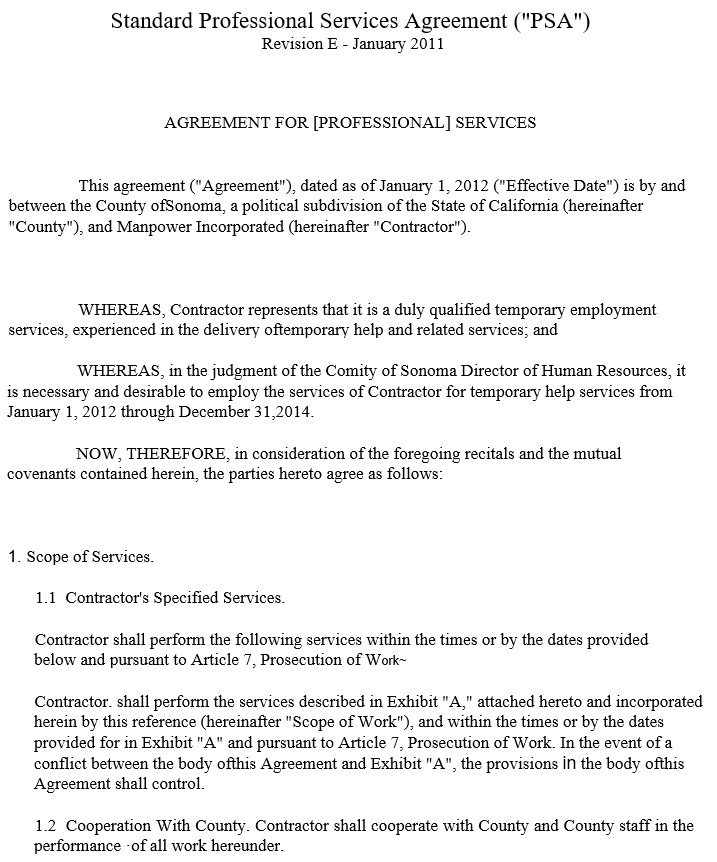
standard professional services agreement
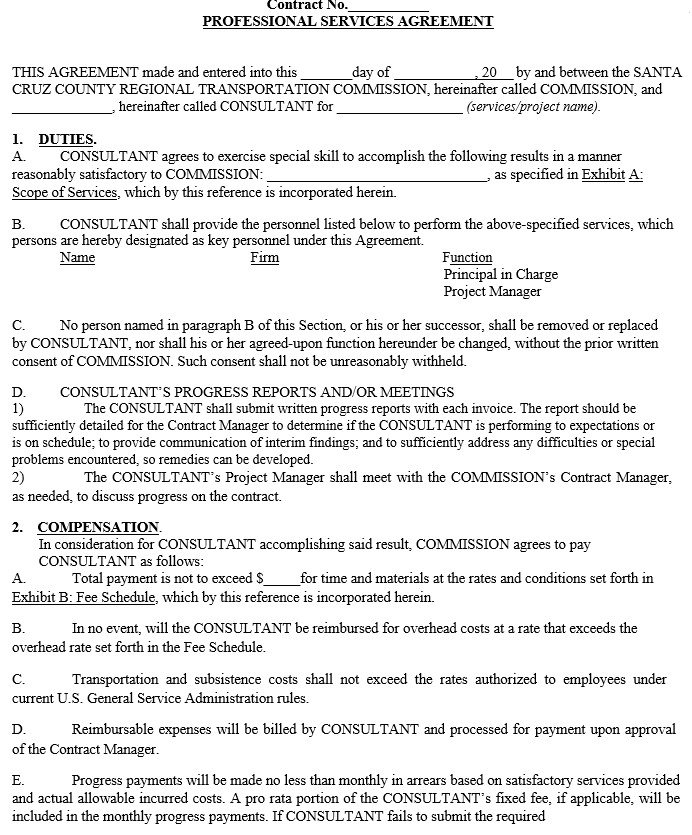
service agreement template
service agreement template word
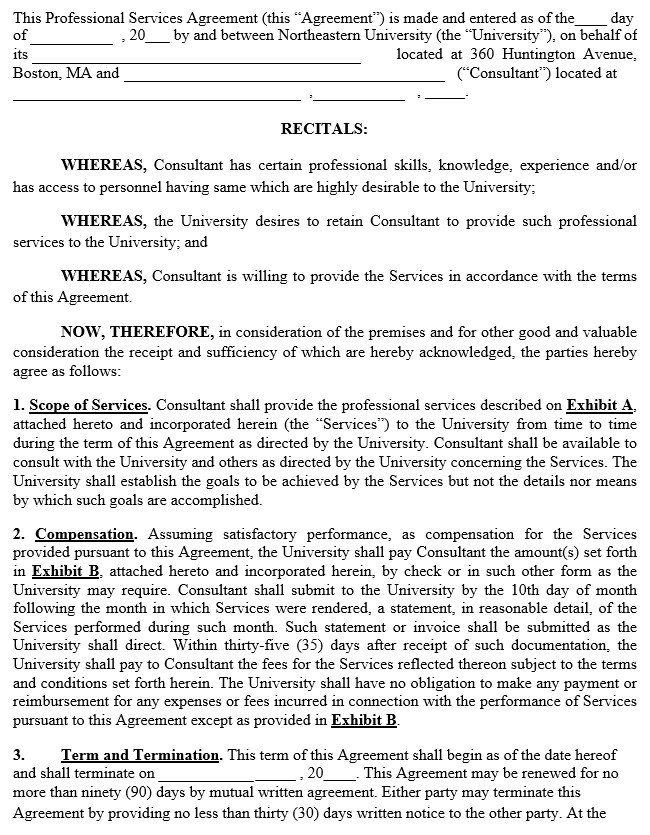
sample professional services agreement for a contractor position
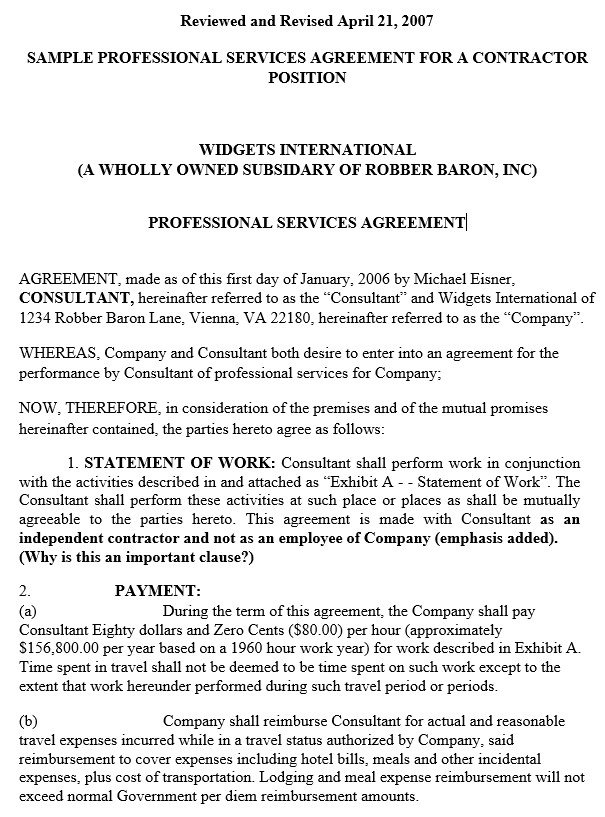
professional services agreement template
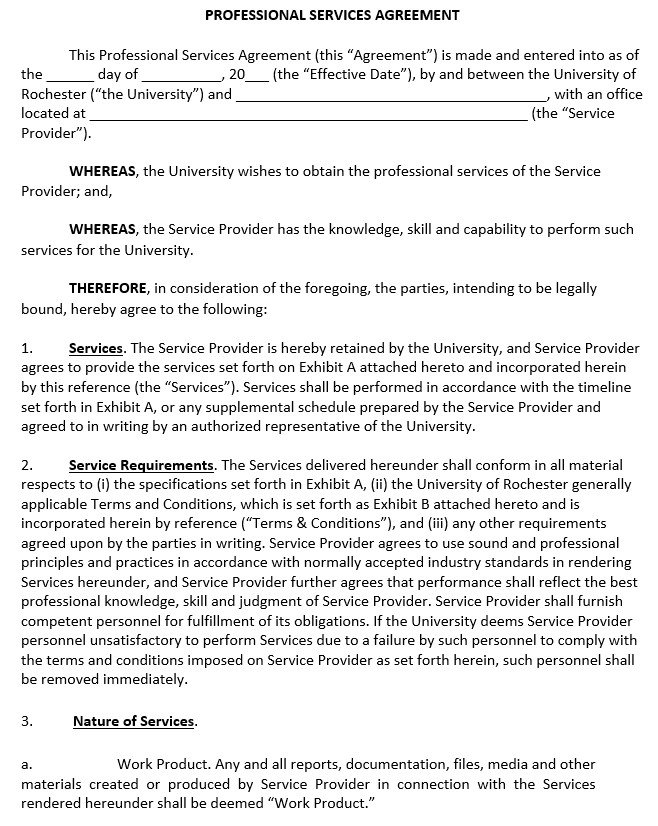
management services agreement
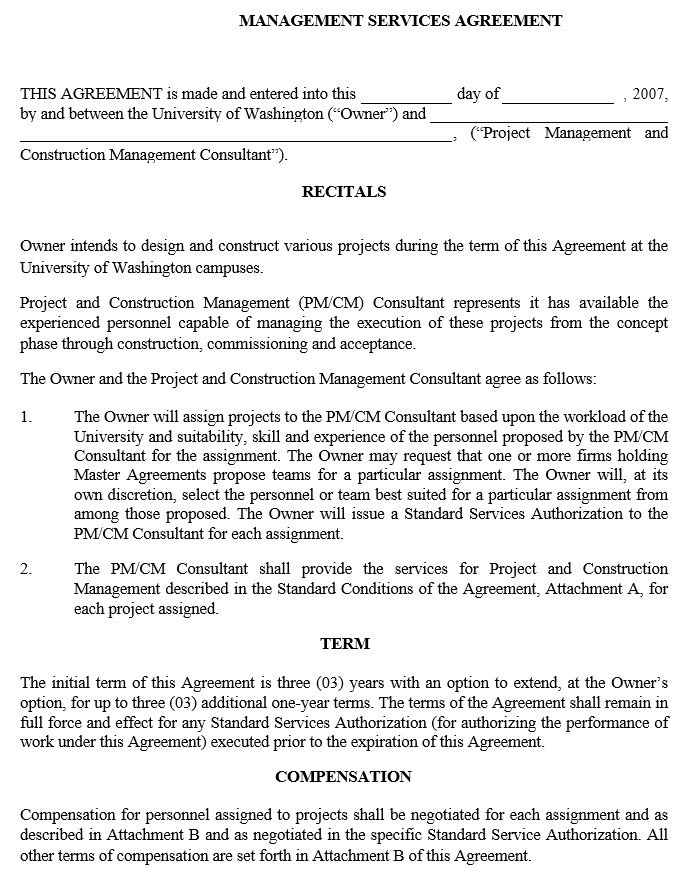
independent contractor service agreement
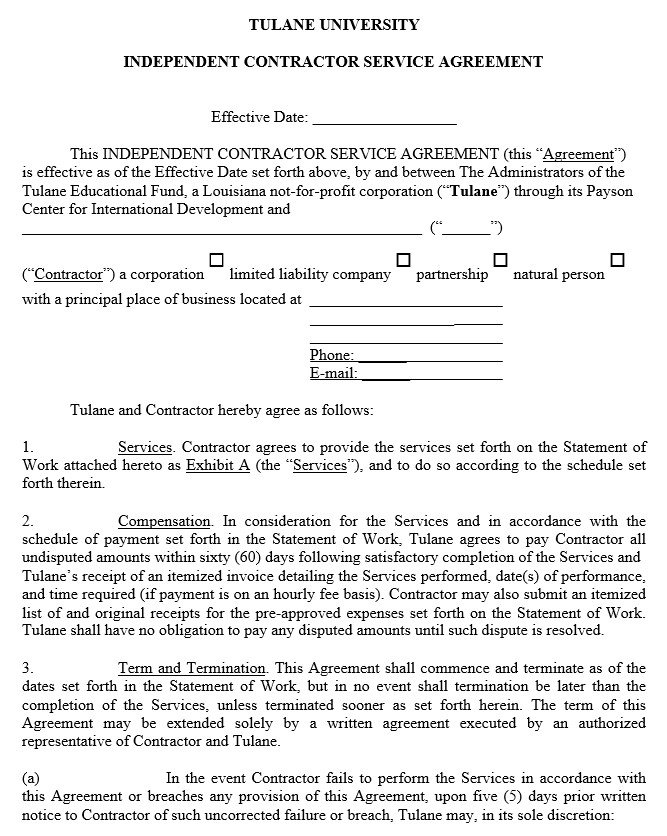
engineer design professional services agreement template
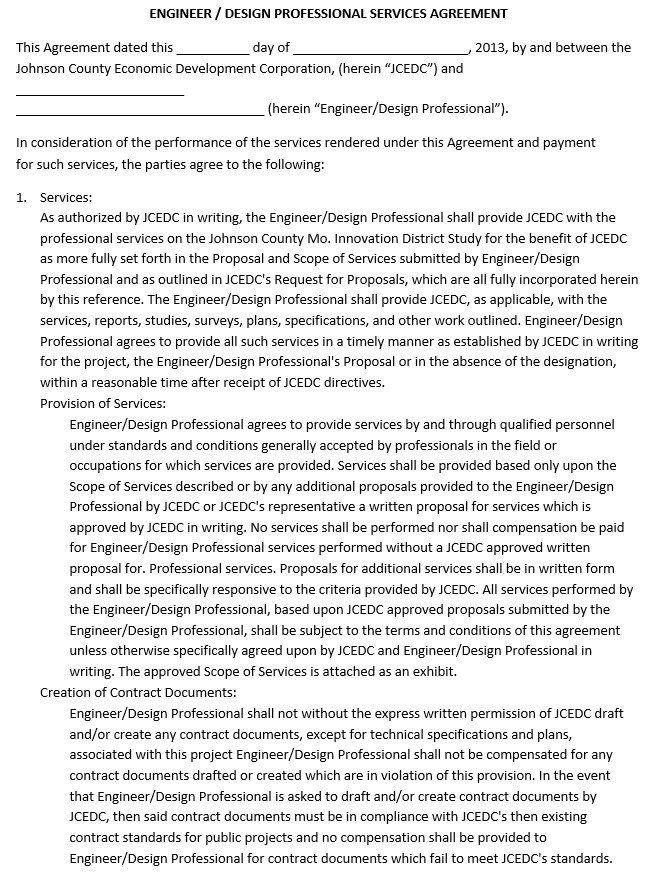
Frequently Asked Questions About Service Agreement Templates
Why should I need a service agreement?
You should need a service agreement to eliminate any confusion between parties about the nature of the work to be performed.
How to terminate a service agreement?
You can terminate the service agreement in the following circumstances;
- If either of the party violates the conditions of the agreement.
- If either of the party provides written notice to another party on the basis of the agreed notice period.
Can I create my own service agreement?
Yes, many individuals and businesses begin with a service agreement template and customize it. However, professional legal review may be valuable when the project involves large payments, sensitive information, intellectual property, regulated services, or significant liability.
Does a service agreement need to be notarized?
Most ordinary service agreements do not require notarization. However, requirements may vary based on local law and the type of transaction.
What is the difference between a service agreement and a statement of work?
A service agreement generally contains the overall legal terms of the business relationship. A statement of work focuses on a specific project, including deliverables, deadlines, and fees.
You May also Like
 Free Credit Report Authorization Form (Word / PDF)
- Free Printable Lead Based Paint Disclosure Form (PDF)
- Printable Medical Expenses Tracking Spreadsheet [100% Free]
- Printable Codicil To Will Forms (Word)
- Free Iowa LLC Operating Agreement Template (Word / PDF)
- Free Time Card Template Excel & Word [Daily, Weekly, Monthly]

![Printable Medical Expenses Tracking Spreadsheet [100% Free]](https://exceltmp.com/wp-content/uploads/2019/09/medical-spreadsheet-template-150x150.jpg)
![Free Time Card Template Excel & Word [Daily, Weekly, Monthly]](https://exceltmp.com/wp-content/uploads/2021/04/employee-time-card-template-150x150.jpg)
